Work and case studies
How I build, and what I build: guardrails first.
Tools I have designed and built with AI coding tools, five of them written up in full as short case studies you can download. They start with the two largest: Studio, where a team of AI agents takes on a marketing team's production work, with a real person approving every step that spends, publishes, or replaces work; and RFI Respond, which shows how AI can be designed into a knowledge-heavy business process to make it faster, more accurate, and more repeatable. Job Scout follows one agentic system from design to daily use; How I build with AI sets out the method behind all of them, running AI as an engineering team; and Task oversight applies that method to a small product whose full code is public on GitHub. In each, safety, privacy, and the limits on what a system may do are settled before the first line of code is written.
Never list firstWhat a system must never do is agreed at the start, and enforced by design rather than by instruction alone.
Data has boundariesWhich part may see which data is decided before what to build. Some data no AI ever reaches.
Authority is earnedRead-only first. An AI acts on its own only after it has been tested, and every action can be undone.
Evidence, not assertionTests before code, an independent reviewer, bars set in advance, and a red team that plays the attacker.
The safety and governance techniques behind these principles →
Multi-agent product build
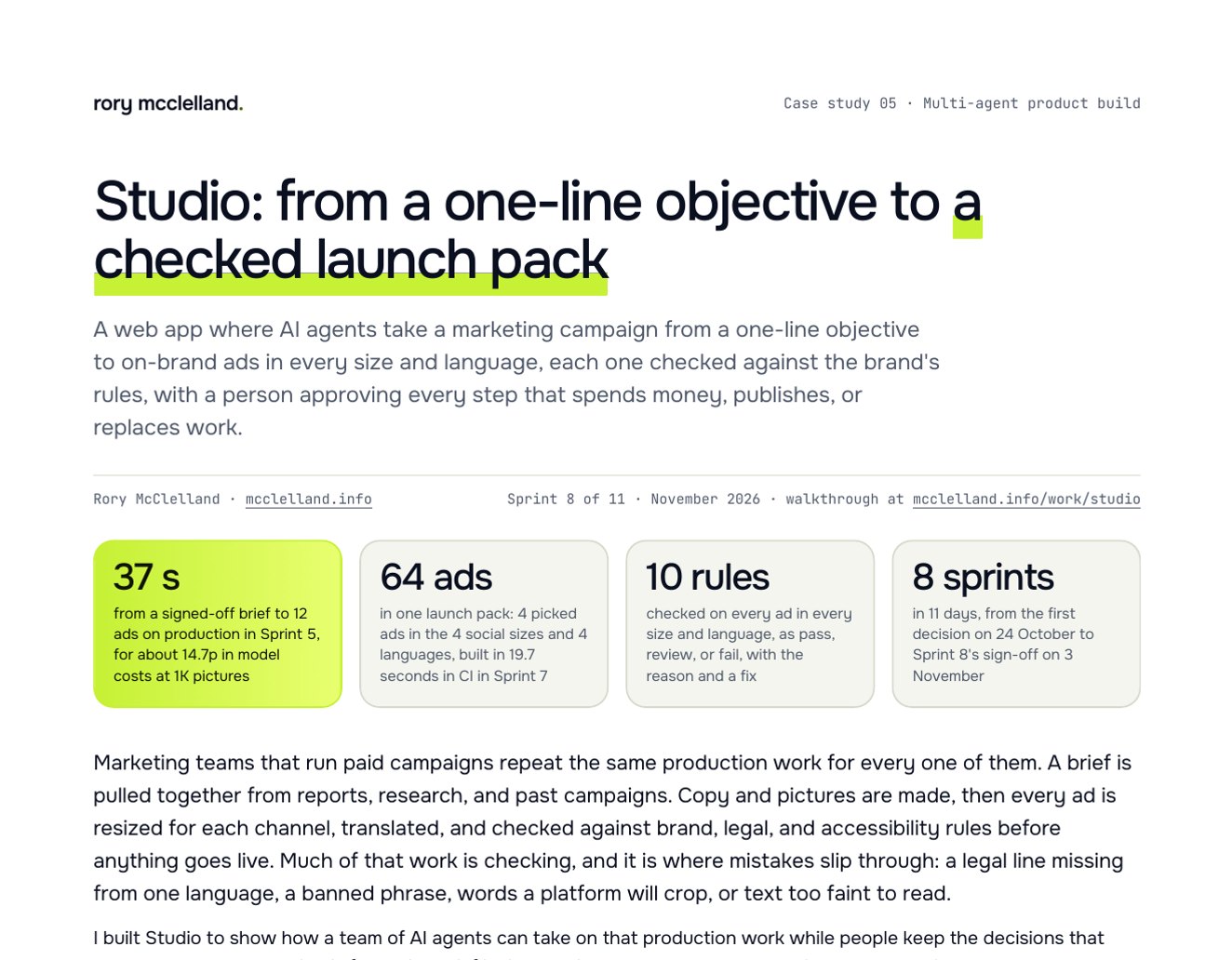
Studio: from a one-line objective to a checked launch pack
- The problem
- A marketing team with a good campaign idea still has to turn it into dozens of ads: every size, every channel, and every language, each one checked against the brand's rules. That production work tends to be slow and repetitive, so campaigns can launch late and fewer ideas get tested than the team would like.
- Who has it
- Brand and campaign managers, and the designers and reviewers who support them.
- Why this problem
- Most of the work is high in volume and low in judgement, however the few judgement calls in it (spending money, publishing, replacing approved work) carry real risk. That makes it a fair test of whether AI agents can take on the production whilst a real person keeps every consequential decision.
- What was left out
- Video, publishing to live ad platforms, and real performance data. Studio stops at a checked launch pack, which a person takes from there.
A web app where AI agents take a marketing campaign from a one-line objective to on-brand ads in every size and language, each checked against the brand's rules, with a real person approving every step that spends money, publishes, or replaces work. Built in eight sprints over eleven days, with me as product manager and Claude as lead engineer, and running for invited users with fictional brands and simulated data. It is a non-commercial demonstration, inspired by multi-agent campaign platforms I saw at Elsewhen and built independently. The case study covers what the product saves a marketing team, how it is built, deployed, and run, and how AI built it safely.
- On production in Sprint 5, a signed-off brief became 12 ads in 37 seconds for about 14.7p in model costs, and a daily spending cap is checked before every model call.
- The image model never draws text: words, logos, and legal lines are composed in code, so they are drawn exactly as written.
- Ten rules run on every ad in every size and language, and only files that pass, or that a person has accepted, reach the launch pack.
- Since Sprint 7, each sprint has been signed off from a page built from recorded browser tests, after an independent QA agent and reviewer have checked the work.
AI product build
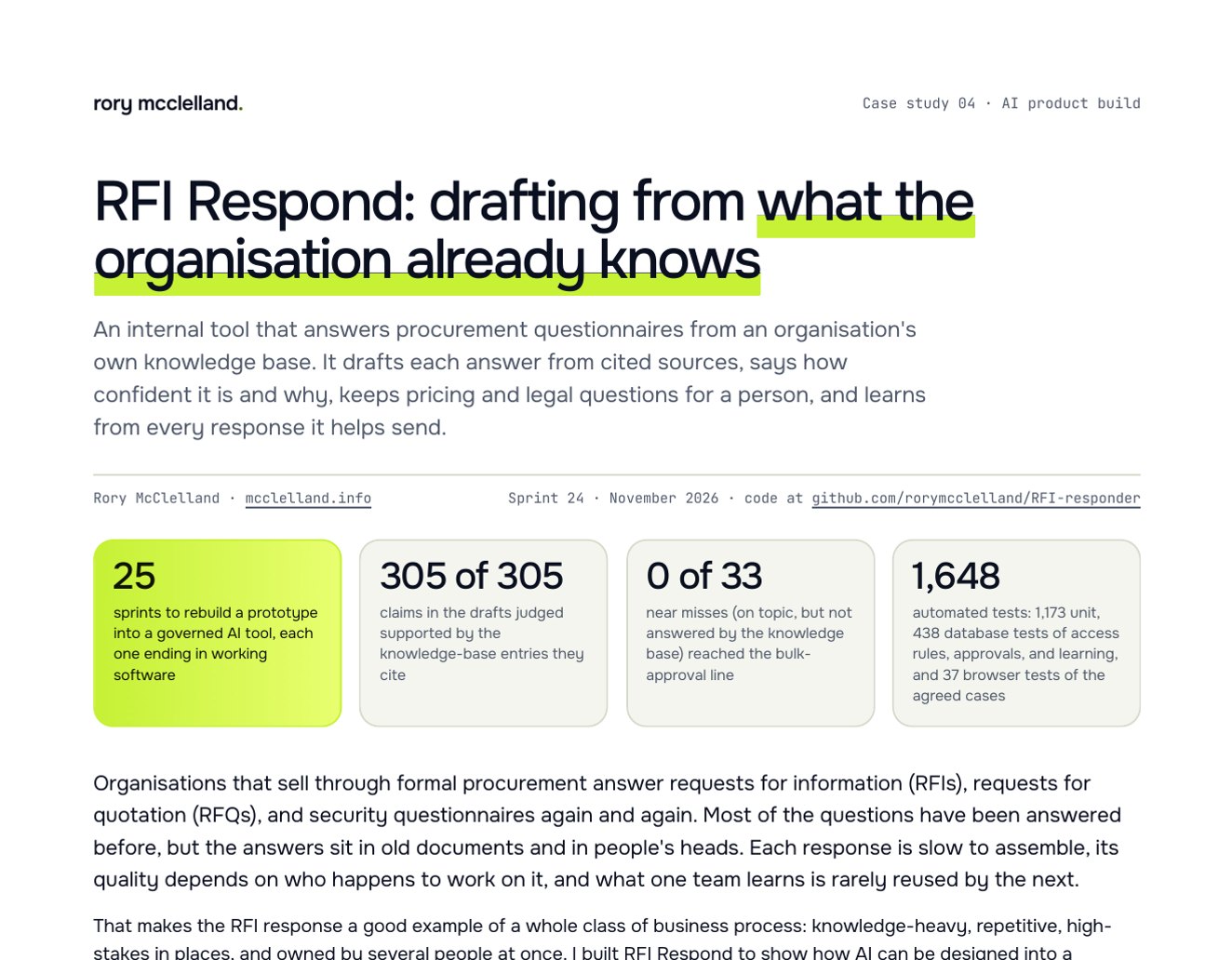
RFI Respond: drafting from what the organisation already knows
- The problem
- Organisations that sell through formal procurement answer the same questionnaires again and again. Most questions have been answered before, however the answers sit in old documents and in people's heads. Each response is slow to assemble, its quality depends on who happens to work on it, and what one team learns is rarely reused by the next.
- Who has it
- The person responsible for sending each response, and the subject experts who are chased for answers.
- Why this problem
- What sits underneath is institutional knowledge that is never captured. The questionnaire is simply where the cost shows. Solving it here leaves a knowledge base the organisation can reuse in support, HR, onboarding, and bids.
- What was left out
- It is not a CRM, and it never sends anything to a customer. Pricing and legal questions always go to a person, and pricing is never drafted or learned.
An internal tool that answers procurement questionnaires from an organisation's own knowledge base, rebuilt over twenty-five sprints from a prototype first made in three hours for a job interview, and now running as an invite-only demo where a visitor can try it on a sample questionnaire. It shows how AI can be designed into a knowledge-heavy business process to make it faster, more accurate, and more repeatable, and how the same pattern carries over to support, HR, onboarding, bids, and other flows.
- Drafts only from cited sources, checked in code: all 305 claims in the test drafts judged supported, and the judge caught 95 of 95 planted ones.
- Confidence is calibrated, not guessed; bulk approval needs the checker's "yes", and pricing and legal questions always go to a person.
- The knowledge base learns from every response, with provenance, review dates, and an admin's review of members' changes.
- Every agreed test case runs as a browser test on every push, including on a staging copy with the real AI, and I sign off each sprint from a page of recordings.
Agentic application
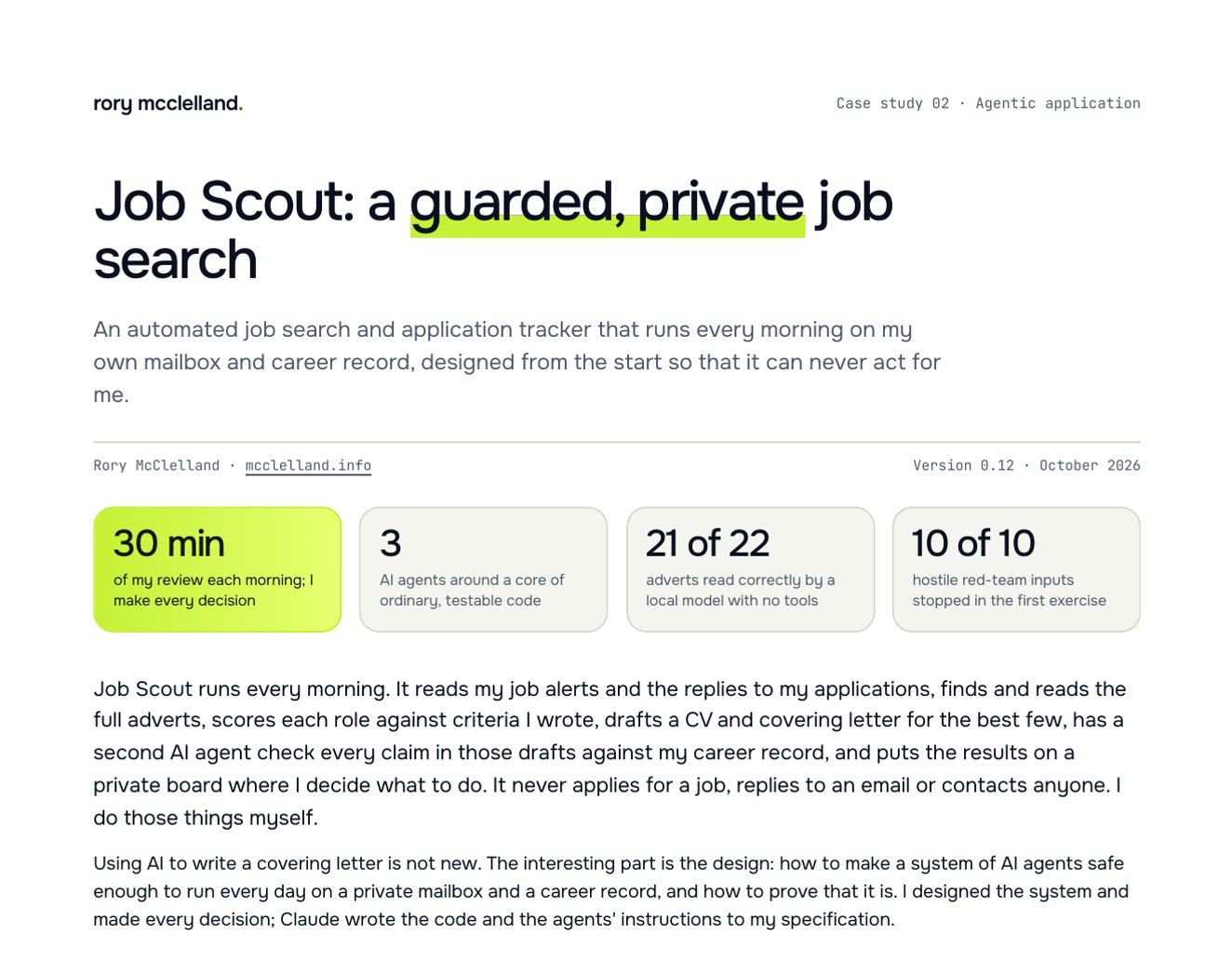
Job Scout: a guarded, private job search
An automated job search and application tracker that runs every morning on my own mailbox and career record. It reads alerts and replies, reads the full adverts, scores each role, drafts a CV and letter for the best few, has a second agent check every claim, and lays it all out on a private board. It never applies, replies or contacts anyone; I make every decision. A demo copy, running on made-up data, is public on GitHub.
- Adverts and emails are read by a model on the local PC, with no tools and no internet access; only a checked summary leaves the machine.
- An independent reviewer must quote the career record for every claim it accepts, and code confirms each quote exists.
- Measured, not assumed: 21 of 22 adverts read correctly, and all ten hostile red-team inputs stopped.
Way of working
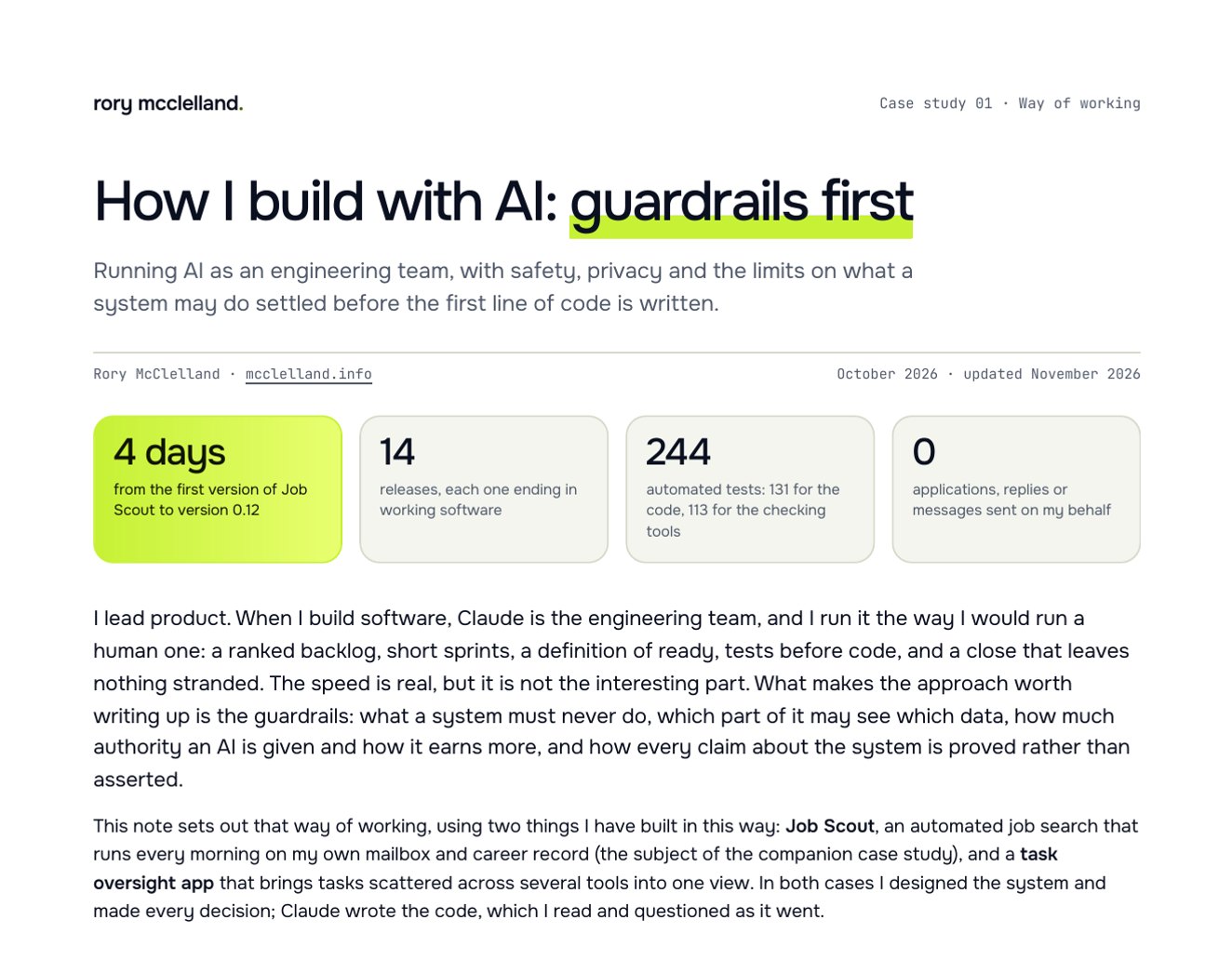
How I build with AI: guardrails first
When I build software, Claude is the engineering team, and I run it as I would a human one: job stories, a ranked backlog, short sprints with a definition of ready, tests before code, and a close that leaves nothing stranded. The note covers where my approach to privacy comes from, the build cycle, and the seven guardrail principles I apply to anything that uses AI, with examples from two of my own builds.
- An AI agent only where isolation, independence or on-demand use calls for one; everything else is ordinary, testable code.
- Text written by strangers is treated as data, never as instructions.
- A paper trail a reviewer would ask for: decision log, system card, threat model and a risk register organised by the NIST AI Risk Management Framework.
Download the PDF ↓5 pages · A4
Read the summary: how the build runs →
Product build
Task oversight: one list I can trust
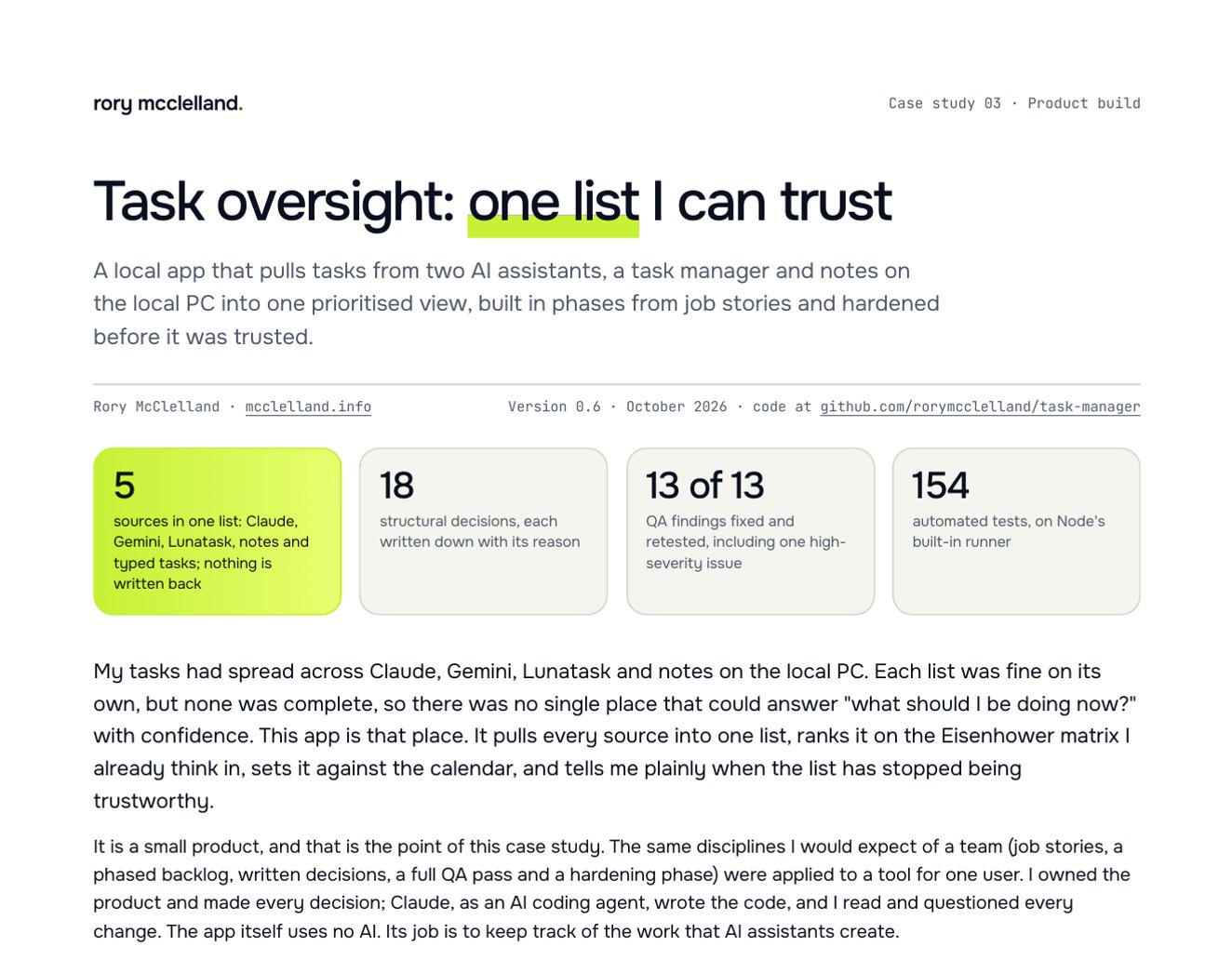
My tasks were spread across two AI assistants, a task manager and notes on the local PC, and no single list was complete. This app pulls them into one view, ranks them on an Eisenhower matrix and sets them against the calendar. It was built in seven phases from a job-story backlog, with every structural choice written down, and the full code and documentation are public.
- Local only: tasks stay in one file on the local PC, every source is read-only, and only the app's own page may change a task.
- Nothing is ever deleted, and a task file the app can't read is never overwritten.
- 18 written decisions, and a full QA pass whose every finding was fixed with a test that failed first: 154 tests in all.
Earlier build
An earlier tool, designed from the ground up and built with an AI coding tool. It does not use AI itself: I wrote the requirements, and the tool wrote the code. It is next in line for the same rebuild as RFI Respond.
Asynchronous by default · built with an AI coding tool
Meeting Tool
Built on the principle that work should be asynchronous by default. It is designed to follow Slack and email conversations and suggest a meeting only when ambiguity, confusion and frustration reach a set level, then find a free slot and send the invitations.